
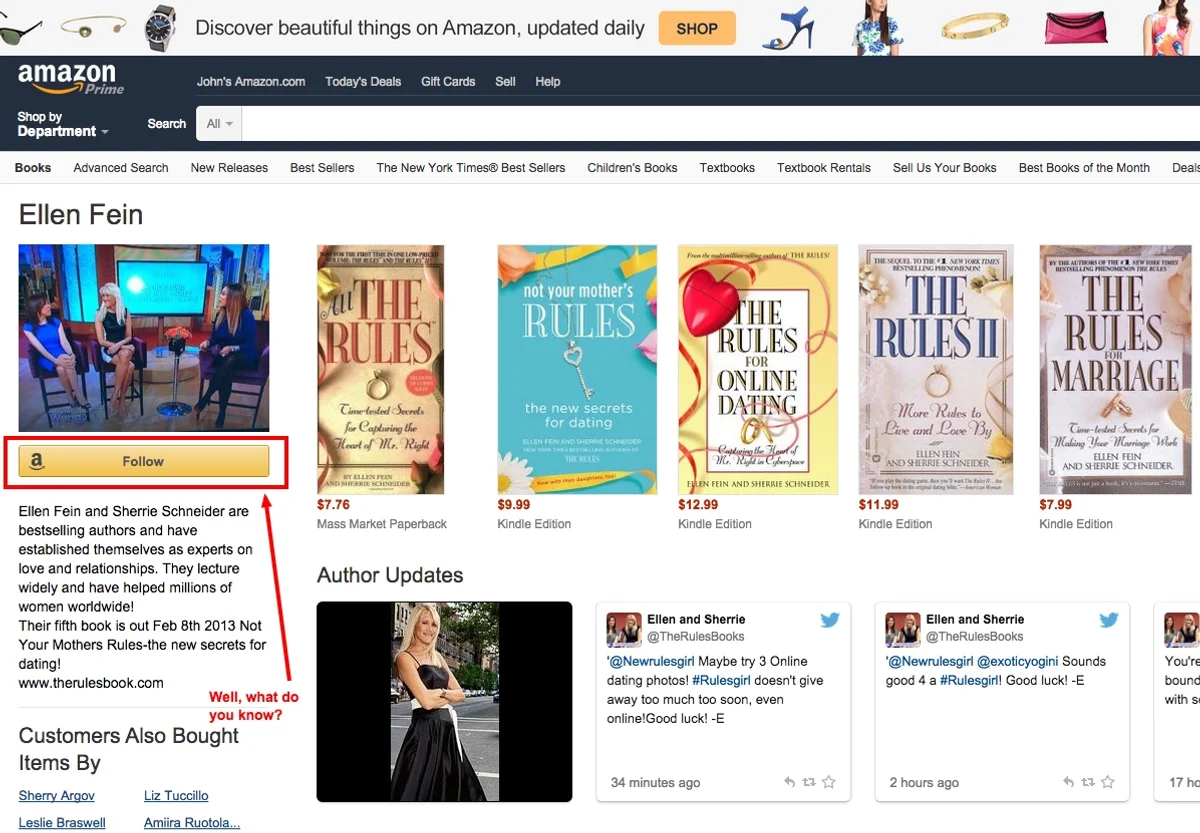
Sometimes, often more rarely than we would like, what we think is a really good idea actually turns out to be a really good idea. Case in point, in a little bit of self-congratulatory back-patting, I have the pleasure of pointing out that an idea I expressed on this very blog actually went on to become a real, live feature on Amazon.com.
First, a little background. In early 2013 I wrote this article about an feature request for Amazon. It was a personal plea, really. What I wanted was a feature to be able to “follow” authors and musicians that I cared about. I, like many others I assumed, often had the experience of only finding new music/books by accident, sometimes six months after something new came out.
This seemed like a missed opportunity. Specifically, here I was, an active, engaged consumer, just waiting to spend my money on something new. I was a “fan” of these artists, and as such, I was very likely to probably purchase whatever they produced next. But, because of how informationally-bombarded I am, I am loathe to subject myself to yet another email list or social media relationship. For Amazon, I was low-hanging fruit, with the locks on my wallet already loosened. I was primed to buy.
Specifically, what I lobbied for was a “follow” button. What I wanted was some sort of notification when an artist I liked (or, “followed”) came out with something new. This seemed like an obvious piece of functionality, a piece of functionality that would benefit all involved. It would be a win for the artist (they could engage their “fans” with new items available for purchase), a win for Amazon (they would have a way to do very targeted marketing to customers, for free), and a win for me (I would be able to order things from people I liked as soon as they were available). Actually, the boon for the artist seemed to be the most notable, in that I could imagine them using this functionality to create pre-sales, buzz, etc. Again, win/win/win.
Not long after I wrote the original article, perhaps a week or so, someone from Amazon actually read it. Then, a few days later, someone else. All told, the article was accessed by someone (or some people) at Amazon a total of five times.
But, that was over two years ago. I had actually forgotten about the idea, dismissing the idea as something that would help me, but not something with enough mass appeal to either sway Amazon, or have them think of it on their own.
Then, the other day, I noticed something new. There it was, a “follow” button on an author page. And, it worked basically the way I had imagined it in 2013. In fact, the functionality was even more elegant, because once you “followed” an author, you were given the option to follow similar authors. Nice touch, Amazon, adding a bit of associative virility to it.
It’s not every day that you see one of your ideas, pretty much as-imagined, on one of the biggest websites in the world. Even better, it is not every day that you see something that you think could help the artists you care about built-out (and very well-executed).
Sure, it’s possible that Amazon thought of this on their own. I have no idea how long this feature has been there, and referencing a two-year-old blog article is a little thin. To me, it was pretty obvious functionality, but I choose to believe that maybe, just maybe, I had some part in this feature. Is it minor? Probably. Is it just ego? Almost certainly, but sometimes you need to take a victory lap after a victory. What I do know is, turns out, that this was a very good idea, and that’s nice to know.
Founder, 1123Interactive
25+ years building products, from consumer electronics scaled to $5M to production SaaS shipped in weeks. Helping founders and businesses turn ideas into working software.
Learn moreContinue Reading
Working for Equity Is a Free Plan You Can't Upgrade
You set your price at zero for six months, and now you need money. Why equity renegotiations run downhill, and what has to be in the deal on day one.
Freemium Trades Friction for Friction
Removing the price removes the friction, and the commitment goes with it. Why free users don't upgrade, and what a credit card at signup actually buys you.
Don't Take a Share in a Business That Doesn't Exist Yet
The rule underneath everything I've written about equity, stated once and plainly. When to pay cash, when shares are legitimate, and what to do before then.